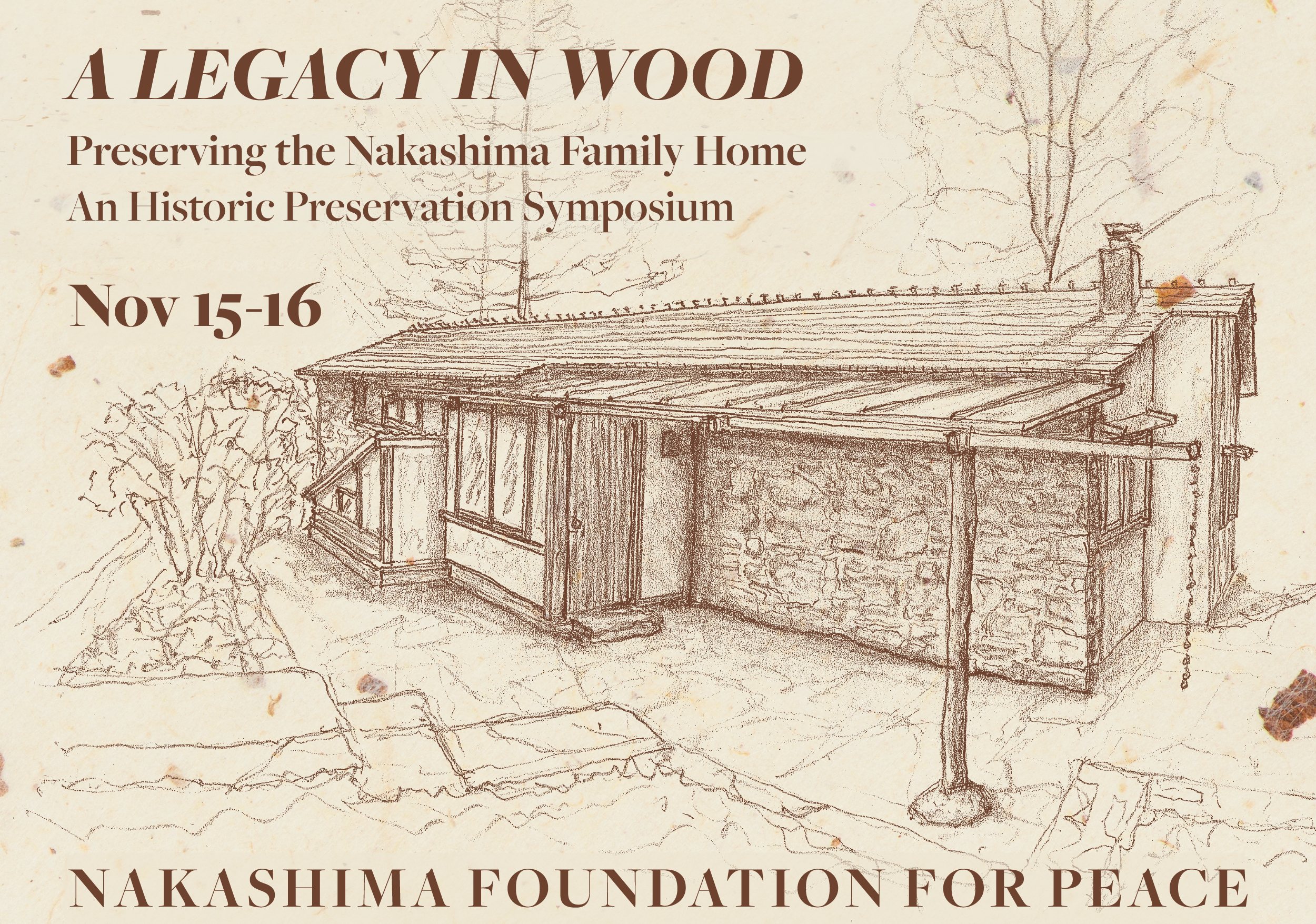
Delve into the architectural and cultural significance of George Nakashima’s family home, a National Historic Landmark recognized for its innovative design and craftsmanship.
Built in the 1940s, the Family House reflects Nakashima’s unique integration of modernist principles with traditional Japanese design elements, emphasizing natural materials and craftsmanship.
Through archival research, expert presentations, and discussions on ongoing preservation efforts, the symposium will highlight both the challenges and opportunities in preserving this iconic home, while exploring how new discoveries continue to enrich our understanding of Nakashima’s legacy.
Join us on November 15 – 16, 2025, as we delve into the architectural and cultural significance of George Nakashima’s family home, a National Historic Landmark recognized for its innovative design and craftsmanship.
Built in the 1940s, the Family House reflects Nakashima’s unique integration of modernist principles with traditional Japanese design elements, emphasizing natural materials and craftsmanship.
Through archival research, expert presentations, and discussions on ongoing preservation efforts, the symposium will highlight both the challenges and opportunities in preserving this iconic home, while exploring how new discoveries continue to enrich our understanding of Nakashima’s legacy.
SCHEDULE
Day 1 - Saturday, November 15th
9:30am – 10am : Check-in and coffee
10am – 11:45am : Nakashima Family House and History Panel Discussion
12pm – 1pm : Lunch
1pm – 2:45pm : Nakashima Family House Preservation Project Team Panel
3pm – 4pm: Nakashima Woodworkers Campus Preservation Tour
4pm – 5pm: Cocktail Reception
Day 2 - Sunday, November 16th
10am – 12pm : Guided Tour of Nakashima Woodworkers Campus
12pm – 1pm : Lunch
1pm – 2:45pm : Guided Tour of Historic Raymond Farm
BACKGROUND
In 2024, the Nakashima Foundation launched a study of the Nakashima Family House. George Nakashima built the House himself, yet we had no detailed drawings to document its design or how it evolved over time. Working with our partners at the University of Pennsylvania’s Center for Architectural Conservation, Department of Historic Preservation, we developed a full set of preservation documents, including architectural drawings and a Historic Structure Report.
The documentation process was as innovative as the building itself. Using laser scanning, 3D modeling, and archival research, we uncovered the layered evolution of the House and the logic behind its design and construction. The symposium will share details of this process, what we uncovered, and what it means for the future.
In 2024, the Nakashima Foundation launched a study of the Nakashima Family House. George Nakashima built the House himself, yet we had no detailed drawings to document its design or how it evolved over time. Working with our partners at the University of Pennsylvania’s Center for Architectural Conservation, Department of Historic Preservation, we developed a full set of preservation documents, including architectural drawings and a Historic Structure Report.
The documentation process was as innovative as the building itself. Using laser scanning, 3D modeling, and archival research, we uncovered the layered evolution of the House and the logic behind its design and construction. The symposium will share details of this process, what we uncovered, and what it means for the future.
SPEAKERS
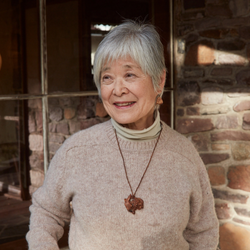
Mira Nakashima
President and Creative Director of George Nakashima Woodworkers, and President of the Nakashima Foundation for Peace.
Mira Nakashima is the daughter of Japanese-American woodworker and architect George Nakashima, and since 2004 has been President and Creative Director of George Nakashima Woodworkers and President of the Nakashima Foundation for Peace. Mira was born in 1942 in Seattle, Washington, graduated cum laude from Harvard University with an undergraduate degree in Architectural Sciences and General Studies, and earned her master’s degree in Architecture from Waseda University in Tokyo.
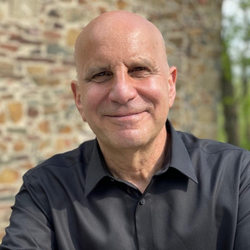
John DeFazio, AIA
Architect, Founder and Executive Director of the Raymond Farm Center of Living Arts & Design.
Born in Brooklyn, John DeFazio lives and practices architecture and planning in New York City. He is a New York Institute of Technology graduate where he teaches architectural Thesis studio. He also teaches thesis in the study-abroad program (Japan, Netherlands, Barcelona) and architectural theories at Westphal College, Architecture, Interiors, and Urban Design, Drexel University, Philadelphia. He is a writer on art, architecture, and planning and has contributed to Art in America and Residential Design Magazine.
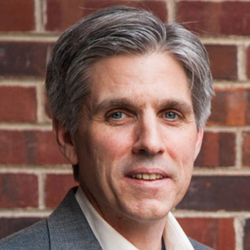
William Whitaker
Director and Chief Curator of the Architectural Archives of the University of Pennsylvania Weitzman School of Design.
William Whitaker is the curator and collections manager of the Architectural Archives of the University of Pennsylvania Weitzman School of Design. Trained as an architect and architectural historian at the University of New Mexico and the University of Pennsylvania, Whitaker primarily works on documenting and interpreting Penn’s design collections. He has lectured on a wide range of subjects related to twentieth century architecture, landscape, and community design.
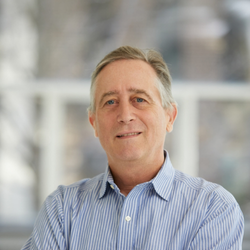
John Hinchman
Senior Research Associate
John Hinchman is a Senior Research Associate in the Center for Architectural Conservation at the University of Pennsylvania Stuart Weitzman School of Design, where he serves as Operations Manager. He focuses on the integration of digital technology in the conservation field, and teaches courses which focus on developing an understanding of the use of diverse software packages as a single integrated tool in Historic Preservation, as well as Documentation II which provides an introduction to the survey and recording of historic buildings and sites.
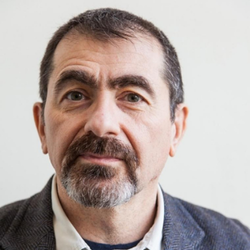
Frank Matero
Professor of Architecture and Chair of the Graduate Program in Historic Preservation at the University of Pennsylvania Stuart Weitzman School of Design.
As an educator and conservation practitioner, Frank Matero has shaped architectural conservation discourse and practice in the US and abroad. He is Professor of Architecture and directs the Department of Historic Preservation at the University of Pennsylvania Stuart Weitzman School of Design. He is Director and founder of the Center for Architectural Conservation, a member of the Graduate Group in the Department of Art History, and Research Associate of the University Museum of Archaeology and Anthropology.
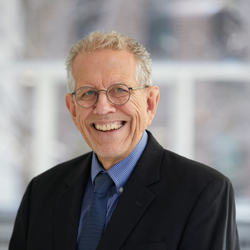
Michael Henry
Habitat Conservation Planner, Architect, and Adjunct Professor at University of Pennsylvania Stuart Weitzman School of Design
Michael Henry was Principal Engineer/Architect and founding partner of Watson & Henry Associates and is Principal at Michael C. Henry, LLC. He has consulted to institutions, cultural heritage stewards and architects/engineers on conservation of heritage buildings and collections. Michael is Adjunct Professor of Architecture in the Department of Historic Preservation at the Weitzman School of Design, University of Pennsylvania. He is a guest lecturer at the Winterthur/University of Delaware Graduate Program in Art Conservation.
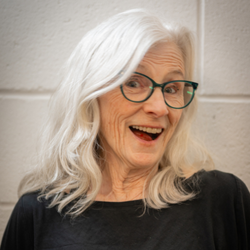
Wendy Jessup
Conservator
Wendy Jessup is a conservator in private practice. A Fellow of the International Institute for Conservation (IIC) and Professional Member of the American Institute for Conservation (AIC), Wendy is experienced in identifying vulnerabilities and risks to collections and in setting objectives for risk reduction, collections accountability, and preventive conservation. She began her career at the Metropolitan Museum of Art, and worked for Museum of Fine Arts, Boston (MFA) and the Smithsonian Institution. She established Wendy Jessup and Associates, Inc. in 1989 to provide preventive conservation services.
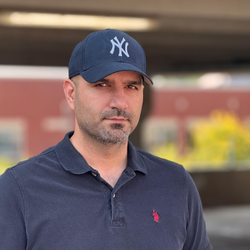
Mojtaba Saffarian
Architectural Staff at John G. Waite Associates, Architecture and Historic Preservation Graduate, University of Pennsylvania
Mojtaba Saffarian is an architectural staff member at John G. Waite Associates, Architects. He holds a Master of Science in Historic Preservation from the University of Pennsylvania. He contributed to several preservation projects across the U.S. through Penn’s Center for Architectural Conservation. The Nakashima Family House served as the case study for his master’s thesis on Building Information Modeling (BIM) applications in preservation. Post-graduation, he continued working at Penn as a research associate, becoming fully engaged in the house’s digital documentation and expanding its use for conservation and interpretation.
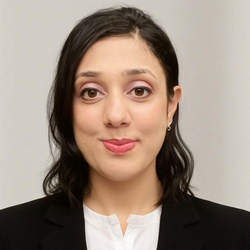
Paridhi Goel
Preservation Associate
REGISTRATION INFORMATION
The symposium will be held on site at Nakashima Woodworkers at 1847 Aquetong Road, New Hope, PA. Parking is free, and individual transporation is required for traveling between the Raymond Farm and Nakashima Woodworkers on Sunday.
Registration cost for the full day of programming on November 15th is $125 per person for attendees, or $75 for students. Registration includes the evening cocktail reception, but lunch is an additional optional cost of $15 per person.
Registration cost for the optional add-on tours of the Raymond Farm Center and Nakashima Woodworkers on November 16th is $150 per person.
Please call (215) 862-1094 or email [email protected] with any questions or concerns.
This event is made possible with support from Visit Bucks County, and our important partners. For more information on becoming a sponsor, please contact [email protected].
This event is made possible with support from Visit Bucks County, and our important partners. For more information on becoming a sponsor, please contact [email protected].