
Mira's Memories

Marion and Mira at the Raymond Farm.
My parents married in Los Angeles in February of 1941 and moved to Seattle where Dad began his first furniture business. In 1942, they were incarcerated on the Idaho desert. Thanks to my father’s architecture professor at MIT, we were invited to live on the Antonin Raymond Farm in Pennsylvania in 1943 to tend the chickens.
In 1945, we moved to an old, small cottage on Aquetong Road with a hand pump for water, a wood-coal stove for heat and cooking, and my father continued making furniture in the garage.
Marion and Mira at the Raymond Farm.
My parents married in Los Angeles in February of 1941 and moved to Seattle where Dad began his first furniture business. In 1942, they were incarcerated on the Idaho desert. Thanks to my father’s architecture professor at MIT, we were invited to live on the Antonin Raymond Farm in Pennsylvania in 1943 to tend the chickens.
In 1945, we moved to an old, small cottage on Aquetong Road with a hand pump for water, a wood-coal stove for heat and cooking, and my father continued making furniture in the garage.
In 1947, he discovered a property with a south-facing slope and persuaded the farmer who owned it to let him live on 3 acres in exchange for labor on his farm. We lived in an old army tent while Dad built his workshop first. My mother and I visited her ailing father in California while my father enclosed the first section of the house.
He dug the foundation, poured the concrete for it and a cistern to store water, as we didn’t have enough money to drill a well, and built the stone wall and wooden framework literally with his own two hands. He found trees in the woods to make posts to hold the roof up, an old barn beam strong enough to do the job, designed and built the concrete fireplace, and poured all the concrete roof-tiles for our first roof. When my mother and I returned from California, Dad had enclosed the living area well enough for us to survive the winter, but aside from the Kitchen and Bath, the Living Room was the entire house.


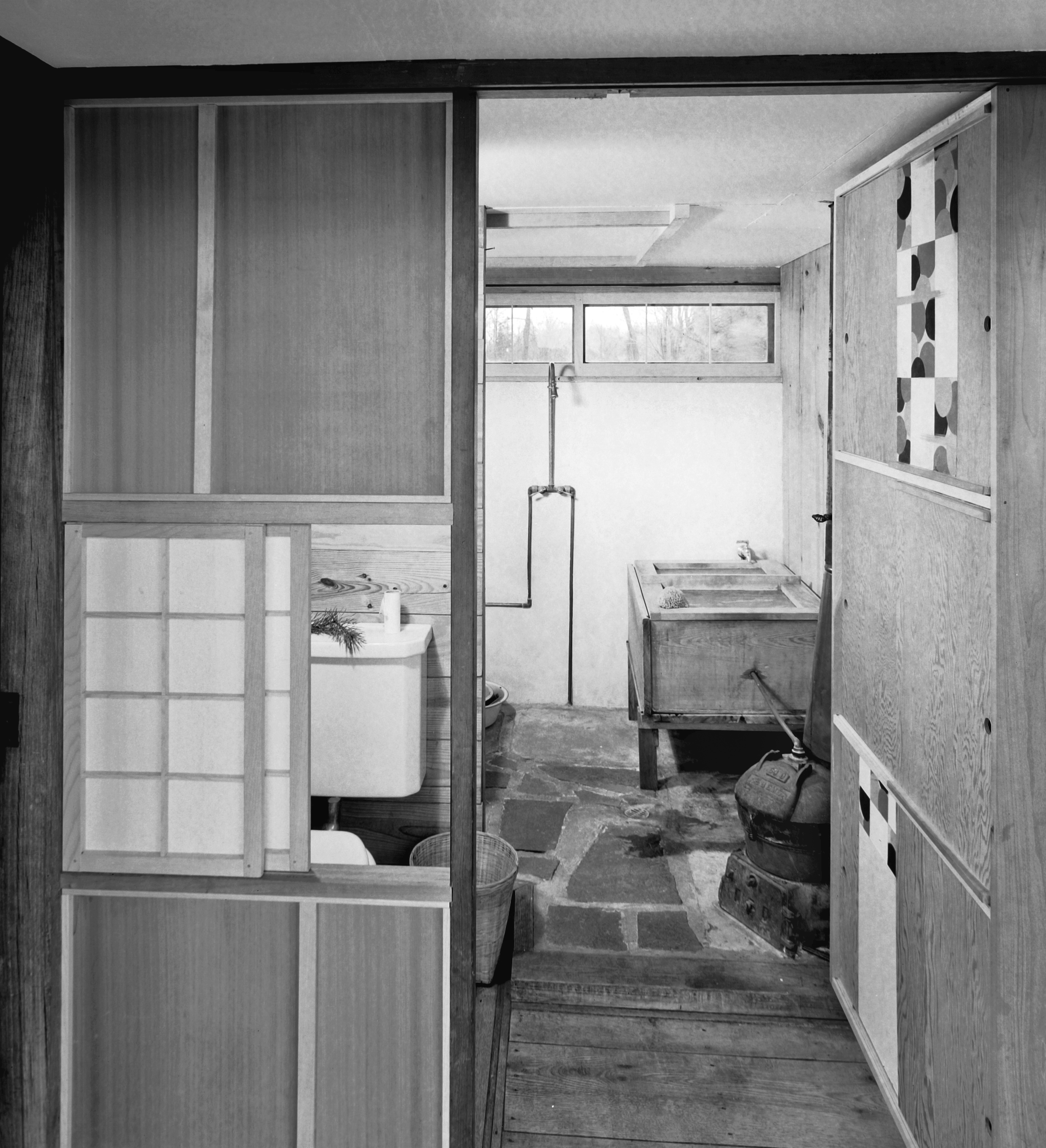
Original bathroom of the Family House. © Ezra Stoller/Esto
I remember the old bathroom had a sliding shoji window one could open and look outside if you wanted to from the toilet chamber. The bath chamber was tiled in flagstone, with a small potbelly stove to heat the water in a rectangular fragrant cedar wooden bathtub.
We took a hot bath once a week, as it took nearly two hours for the water to get heat up; as in Japan, we all washed and showered thoroughly before immersing ourselves; Dad would extricate me and call me a “boiled lobster” because I was all red from the heat!
It must have been around 1954 when Dad replaced the wooden bathtub with a conventional porcelain tub. As my mother was suffering from arthritis, she was treated at an herbal spa for several weeks in Japan and came home with a large bag of herbs which my father insisted on putting into her bathwater and soaking her daily.
In the meantime, Dad added two rooms in the back, with a kerosene heater at the end of the shared closet to heat both bedrooms; the roof became corrugated Transite, and the sunny corridor from front to back was lined with sliding glass window-doors.
I was encouraged to paint murals on my closet doors constructed like “fusuma,” covered with paper and muslin from about 1950-54. I remember a built-in shelf on the north wall where I kept my small glass animal collection. Later, my brother kept his collection of mechanical toys and small cars on that shelf.
The closet was filled with first my clothes, then my brother’s, as well as many books from both our childhoods. I particularly remember the “Little Golden Books” my parents used to periodically buy for me from a very young age; they used to read them to me, along with Alice in Wonderland and Grimm’s Fairy Tales every night before I went to sleep; sometimes, they would make up stories from their imaginations which were very interesting and colorful.
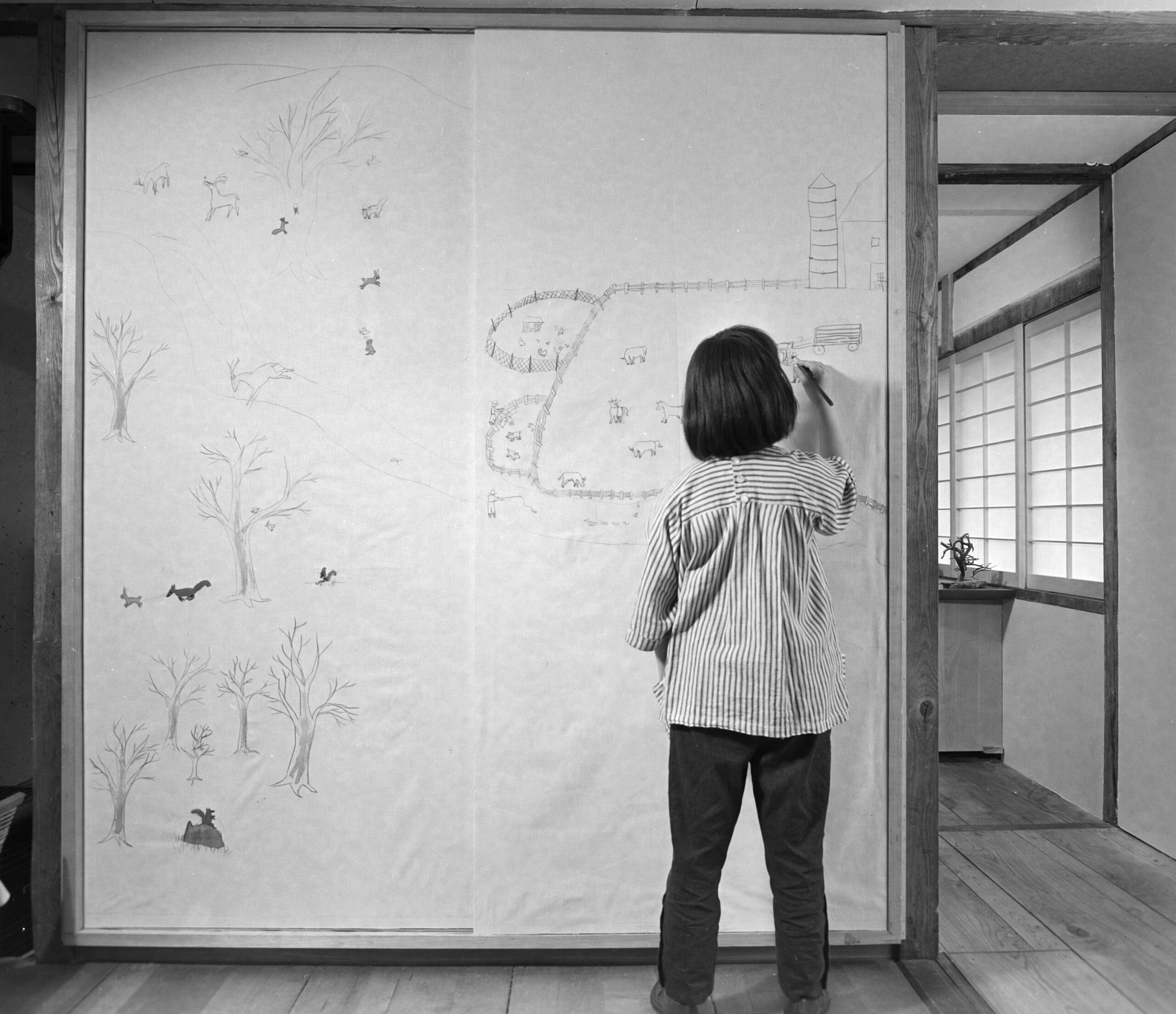
Mira creating her fusuma mural. © Ezra Stoller/Esto
I remember studying the grain in the wood of those bedroom walls, imagining all kinds of creatures living there looking at me, and doing my homework at the desk along the sunny corridor which eventually had sliding shoji screens I could pull closed. I grew up an only child, so my stuffed animals and dolls, some of them made by “Grandma Jonesie,” the cartoonist Chuck Jones’ mother, were my companions and playmates.
When my brother came along in 1954, Dad designed and built a downstairs bedroom for me where he also housed the new hot-water heating system for the house powered by an oil burner.
My room was large and sunny, and had a door which opened onto the back porch and sliding glass-door corridor on the south side of the building. There was a large cherry built-in chest of drawers along my bedroom south wall, and a desk facing West, so the sunlight came in over my shoulder when I was studying.
I don’t think there was much insulation in the walls or ceiling, so it was cold in the wintertime and I used an electric heater, but the room was big enough for a small upright piano, so I used to practice there when I started piano lessons.

Bedroom addition. © Ezra Stoller/Esto
After I graduated from college in 1963, my brother might have moved into my room, but I remember staying there in the summer of 1966 with my first son Satoru and expecting my second child Maria.
I remember waking up one morning with labor pains and asked my father to take me to the hospital; he proceeded very slowly, it seemed, to brush his teeth and shave before getting ready to go, and I pleaded with him to hurry! He was used to my mother’s long labor, but mine was very short. As soon as I was seated in the (thankfully reclining) front seat of his T-bird, my water burst, and I barely made it inside the door of the hospital when my baby girl crowned and was delivered.

Marion, Mira, and baby Satoru.

Interior of Mira’s House. © Ezra Stoller/Esto
Soon thereafter, my mother had a party for us with pink champagne and popcorn and sent us off to Pittsburgh with Dad driving the old T-bird and baby equipment from the Krosnicks’ strapped to the top of the car.
That was my last memory of being in that house; in 1968 or so, my father announced that he had purchased some property across the road and was going to build us a house there, which he did. We moved back around 1970 with our three young children.
Experience a guided tour of the Family House with Mira Nakashima and immerse yourself in her memories of growing up in New Hope.
Experience a guided tour of the Family House with Mira Nakashima and immerse yourself in her memories of growing up in New Hope.